

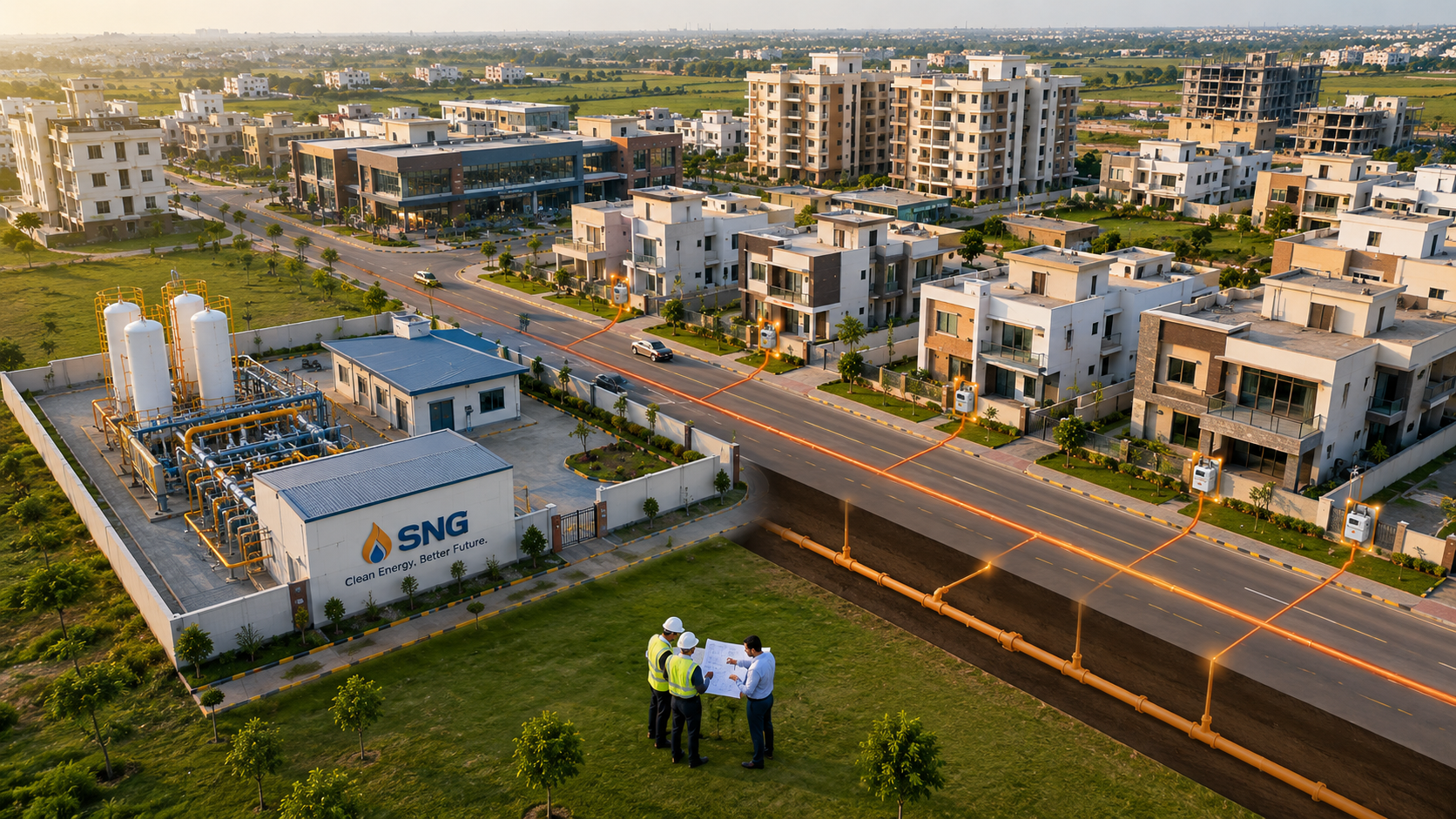
SNG Distribution Company works with housing developers, landowners, builders, cooperative societies, and institutional management bodies to build gas infrastructure that's managed as a long-term utility, not a one-time installation job.
Here's what that partnership actually looks like.
What a Managed Gas Utility Adds to Your Project
A professionally managed gas utility can become an important part of the overall infrastructure of a residential, commercial, or mixed-use development.
Instead of treating gas as an individual consumer responsibility, developers can work with a utility operator to establish an integrated system designed around the project's actual requirements.
- Enhanced project utility profile
- Greater resident and consumer convenience
- Improved project marketability
- Support for occupancy and operational readiness
- Individual residential and commercial metering
- Centralized plant and fuel management
- Phased infrastructure-development options
- Structured consumer onboarding
- Long-term operations and maintenance
- Billing and account administration
- Technical and emergency support
- Reduced operational burden on the project management team
Who Does What?
A managed gas utility partnership is not simply a vendor drop-and-go arrangement.
SNG Distribution Company retains core responsibility for the technical, engineering, infrastructure, operational, metering, billing, tariff, safety, compliance, maintenance, and fuel-management functions throughout the life of the project.
This creates a coordinated utility model where the gas infrastructure is designed, developed, operated, and maintained according to the requirements of the development.
SNG Distribution Company's Core Responsibilities
- Technical and project assessment
- Engineering and system design
- Gas infrastructure development
- Fuel management and LPG procurement
- Pipeline network operations
- Consumer metering
- Billing and account management
- Operations and maintenance
- Safety and technical procedures
- Consumer technical support
What Developers Need to Provide
A successful utility partnership also depends on cooperation from the project developer or management body.
Developer facilitation typically covers the project information, access, permissions, and coordination required to develop and operate the infrastructure effectively.
- Approved layouts and project information
- Consumer and inventory data
- Suitable land for the SNG Grid
- Pipeline right-of-way
- LPG transportation access
- Road-crossing permissions
- Contractor coordination
- Support for local permissions and NOCs
- Protection of installed infrastructure
- Consumer onboarding assistance
- Timely documentation
- Required financial commitments
A Partnership, Not Just an Installation
One of the most important differences between a managed utility partnership and a conventional installation project is what happens after construction.
A one-time installation can provide infrastructure, but a long-term utility model is designed around continued operation.
That means the system can continue to require fuel planning, network monitoring, maintenance, metering, billing, consumer management, technical support, and operational oversight after the initial infrastructure has been completed.
For developers, this reduces the need to manage every gas-related operational requirement independently.
Designed Around the Project
No two developments have exactly the same requirements.
Consumer population, project size, development phases, residential and commercial demand, pipeline routes, available land, storage requirements, and operational conditions can all influence the design of the gas distribution system.
This is why project-specific engineering and planning are important. The utility infrastructure can be developed according to the actual characteristics and future requirements of the development.
What Developers Ultimately Gain
The value of a managed gas utility partnership extends beyond simply providing a gas connection.
It creates a structured utility system that can support the development from initial infrastructure planning through consumer onboarding and long-term operations.
- Better utility planning
- Improved consumer convenience
- Centralized fuel management
- Professional technical operations
- Individual consumer metering
- Structured billing
- Long-term maintenance support
- Technical and emergency assistance
- Support for phased development
- Reduced operational workload
Building Infrastructure That Continues to Work
Modern developments require more than roads, buildings, and landscaping. They require utility infrastructure that can support residents, businesses, and project operations long after construction is complete.
A managed gas utility partnership provides developers with a coordinated approach to gas infrastructure — bringing engineering, fuel management, pipelines, metering, billing, operations, maintenance, and consumer support together within one system.
The exact responsibilities of each party are defined through the applicable project agreement, but the underlying principle remains straightforward:
Planning a New Development?
Explore how SNG Distribution Company can help assess, develop, connect, and operate a managed gas utility system for your residential, commercial, or institutional project.
Discuss Your Project →